
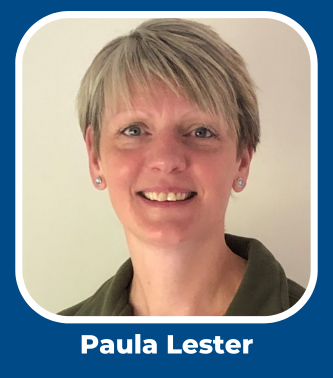
Paula Lester

Paula Lester

Early Education Associate

As a senior leader in Early Years for over 25 years, Paula has managed settings to Outstanding, coached and advised leaders on quality improvement in the Hampshire Advisory Team, led high quality provision as group manager of 12 nurseries, and been director of quality for 32 nurseries. Paula supports leaders, managers, and practitioners to raise the quality of Early Years practice, and has spoken at national conferences. Paula is an experienced Froebelian Travelling Tutor delivering Froebel Trust Endorsed courses in England, Scotland, and Wales. As a Level 7 Executive Coach, Paula supports leaders and managers to understand their own people management style and bring out the best in those they lead. In her role as a quality consultant, Paula has supported settings with all areas of the learning environment and successfully led many settings through their Ofsted inspections supporting them to enjoy the experience and be proud!

Areas of expertise​

  • Leadership and Management

  • Coaching and Mentoring

  • Quality Improvement Support (Preparing for inspection)

  • Action planning for high quality practice

  • Developing high quality environments

  • Outdoor learning

  • Interactions and communication development

Sample courses

Coaching and mentoring – delivered by Paula Lester

This course will enable you to lead and support your teams more effectively. By understanding coaching and mentoring strategies, you will become more self-reflective on your own supporting style. You will learn how to bring out the best in the individuals you manage having an impact on professional and personal lives. Empowering your staff to be the best they can be and feel positive about their role will impact the quality of your provision and therefore improve outcomes for children.

Aims and objectives – Delegates will have opportunities to:

  1. Explore the difference between the terms and why each may be needed and who may benefit from which.
  2. Understand assumptions that are made, and how this impacts on our professional and personal wellbeing and career effectiveness.
  3. Develop realisation of the importance of body language/ non-verbal communication and the difference this makes.
  4. What makes a conversation a ‘coaching conversation’?
  5. Experiment with different styles, what makes someone assertive rather than aggressive?
  6. How to give, and receive, effective feedback.
  7. Capture your next steps to develop your coaching and mentoring skills.
  8. Have a personalised plan to take away and put into practice.

Outdoor learning – delivered by Paula Lester

Everyone has heard of the benefits of being outside but do we really know what this means and why? This course will develop your knowledge of the outdoor world and the unlimited ways it can benefit adults and children in Early Years. We will tackle the challenges which sometimes stop us from being outdoors as much as we would like to be. You’ll struggle to be back indoors afterwards!

Aims and objectives – Delegates will have opportunities to:

  1. Differentiate between playing outdoors and outdoor learning.
  2. Gain experience of how vital being outdoors is to Early Years children learning through play.
  3. Reflect on high quality practice and the importance of the outdoors.
  4. Explore children’s behaviours inside, and outdoors, building links to mental health and benefits to the holistic child.
  5. Investigate what nature can provide with the affordances of the seasons.
  6. Overcome real-life daily challenges and hurdles.
  7. Consider sustainability in today’s climate.
  8. Plan the way forward – I’m on my way, what now?

Quality Improvement Support (Getting ready for inspection) – delivered by Paula Lester

Are you always thinking about that imminent inspection and how to ensure you and your staff are ready to proudly show what you do every day? Are you striving for high quality practice, wanting the children in your setting to experience this every day, but not quite knowing how? Are there areas you feel you could do better in but not sure what needs to change? This course will not only support you to self-reflect and think critically about high quality practice for children and families, but also help you and your staff team prepare to be proud and confident in articulating your practice and showing your best in an inspection.

Aims and objectives – Delegates will have opportunities to:

  1. Explore what is meant by ‘high quality provision’ or ‘best practice’ and why it matters anyway?
  2. Discuss the role of inspectors and what they are looking for and why.
  3. Examine your current practice and areas for improvement.
  4. Develop strategies to improve quality, understanding the foundations of what this looks like.
  5. Explore your thoughts around and what your grade means to your stakeholders.
  6. Reflect on tools you can use to be the best you can be and how to support your staff to shine.
  7. Identify and create a plan of action, with real life strategies to take forward.

Managing transitions and change – delivered by Paula Lester

‘Change is difficult, even good change.’ Managing change is different for everyone regardless of their age. During the Early Years Foundation Stage there are unavoidable transitions such as when a child starts school. This course will look at how we can help prepare children and their families for this big transition in their lives. We will also reflect on many transitions children may be exposed to in your setting that may be avoidable and, if children can be supported by any tweaks to your environment and/or structure of the day.

Aims and objectives – Delegates will have opportunities to:

  1. Discuss what a Transition is and why we are talking about them. So What?
  2. Reflect on the effects of change, however seemingly small, on early years’ children.
  3. Think about children’s behaviour and what can be avoided to support this.
  4. Look at avoidable/non-avoidable transitions and what can be done to manage these.
  5. Consider ‘School Readiness’……and what this really means to you and your children.
  6. Plan strategies to overcome transition challenges you have.

The role of the adult in high-quality interactions and children’s communication development – delivered by Paula Lester

This course examines the role of the adult in high-quality interactions and children’s communication development – it explores:

  • The meaning of both Communication and Interaction.
  • What your curriculum says about Communication and Language development, what inspectors would judge.
  • What this currently looks like for each age group, are requirements being met?
  • Theories of Maslow’s Hierarchy of Needs and Bronfenbrenner’s Ecological System.
  • What makes good, high-quality communication in Early Years.
  • The importance of observation and a ‘can-do’ approach.
  • What makes a high-quality adult-child interaction.
  • How to further support adult-child interactions and communication development in each age group.

This course complements Paula’s course on the importance of the environment – and can be delivered alongside this as part of a full day session.

Environments to best support children’s communication and high-quality adult interactions – delivered by Paula Lester

This course examines how the environment can best support children’s communication and high-quality adult interactions – it explores:

  • The importance of play in developing children’s communication.
  • Equity and Inclusion and what this means for children’s communication development.
  • How transitions are managed to best support children’s communication and adult-child interactions
  • How songs, rhymes, and stories enhance children’s learning of communication and language.
  • Reflecting on current environments in the setting.
  • How to further enhance environments to benefit children’s language and communication.

This course complements Paula’s course on the role of the adult – and can be delivered alongside this as part of a full day session.

Observing children at play – delivered by Paula Lester

What really is play?

How can we know what children are learning in their play?

How do we know we are observing what matters, and do our observations really make a difference?

How can we ensure children have the best possible opportunities to play?

This interactive course will enable participants to reflect on:

  • Why it is so important children have uninterrupted time for play
  • What we are looking for when observing children at play
  • How observations influence our curriculum, planning and the role of the adult
  • How we articulate to others what children are learning through their play

The knowledge and experiences of the group will lead the direction of the discussions but will include:

  • What play is (and isn’t)
  • How play coordinates learning
  • Child developmental stages
  • Schemas
  • Quality observations
  • How the environment influences the quality of play
  • How high-quality play is nurtured by the role of the adult
  • Understanding children’s behaviour

The practicalities:

  • 3-hour session (AM or PM, Twilight or Evening)
  • Suitable for Early Years Settings (Maintained/Non-Maintained) and Schools
  • Relevant for Educators, Support Staff, Teachers and Curriculum Leads
  • This course complements Paula’s course on meeting children’s developmental needs – and can be delivered alongside this as part of a full day session.

Meeting children’s developmental needs – delivered by Paula Lester

How can we ensure all children we teach have a positive learning experience?

How do we know what children are seeking to learn, and how does this influence our curriculum?

How can we ensure we are meeting each child at the developmental stage they are at?

This interactive course will enable participants to reflect on:

  • What children (of all ages) need to thrive.
  • Why knowledge of child development matters.
  • How the adult role, and environment, shape children’s learning.

Discussions will flow using the knowledge and experiences of the group but will include:

  • The importance of Play
  • Observation
  • Structuring the learning environment
  • Schemas
  • Families and the community
  • Valuing childhood
  • Understanding behaviour
  • Risk taking

The practicalities:

  • 3-hour session (AM or PM, Twilight or Evening)
  • Suitable for Early Years Settings and Schools
  • Relevant for Support Staff, Educators, Teachers and Curriculum Leads
  • This course complements Paula’s course on observing children’s play – and can be delivered alongside this as part of a full day session.

Make an enquiry

Enquire about making a booking for your upcoming training today: complete our brief form and we'll provide options, costings, and suggestions to meet your needs - or send us an email to discuss possibilities.

Complete booking enquiry formSend us an email

Looking for something else?

Find another trainer or course here: