Culture and belonging in the early years
by Carla Cornelius Despite living in the UK for the past 27 years, I am made acutely aware that my voice is a puzzle to

by Sue Gifford
Parents may not be as confident in supporting very young children with maths as they are with reading. They may even feel anxious about maths and be tempted to leave it until children get to school. Unfortunately, this is a message which has been conveyed by some early years advisors recently, implicitly or even explicitly, through various webinars and websites giving advice to families about preparation for school.
 A major concern, in considering school readiness, is quite rightly about developing children’s social, emotional and self-care skills as well as their language and communication skills. Alongside these aspects, parents are often advised to encourage imaginative play, singing rhymes and sharing books – but often with no mention of any mathematical activities, like block building or puzzles, or even counting. And yet we know that maths is an area that develops early and is important for later success at school. It is also very relevant to children’s emotional wellbeing, where parents can pass on their maths anxiety to children or alternatively over-pressurise them with inappropriate expectations. If you asked parents about key skills before starting school, quite a lot might wonder what they should do about maths. So why don’t early years experts place greater emphasis on maths?
 I wonder if the lack of engagement with maths shown by some early years advisors and organisations is just symptomatic of the widespread national aversion to maths. Many people seem to have been scarred by their experiences of exams and secondary school maths and perhaps maths has become, for them, a subject of confusing symbols, rigid rules and quick-fire answers. When this is the case for enough people then it becomes publicly acceptable to say you are “not good at maths” in this country. Some “school readiness” guidance suggests that maths is “narrow” or “formal” and belonging to the school curriculum. It evokes images of paper and pencil number tasks, taught in a directed manner. This idea of maths makes teaching it to young children part of the “schoolification” of the early years and a threat to children’s right to play. I wonder if such negative framing of maths encourages some in early years to overlook maths and focus their energies in areas where they are more confident about the value and alignment with early years traditions. This seems reflected in the amount of guidance and professional development about language and early literacy, compared with early maths.
 This is not a trivial issue, as research shows that pre-school maths can make a greater difference to children’s lives than other skills. What children know and understand in maths before they start school predicts how well they achieve later and affects their employment, income and quality of life. Children who lack foundational maths concepts start school on the back foot and are unlikely to “catch up”. Particularly for children from disadvantaged backgrounds, the achievement gap between them and their peers tends to widen throughout school. Unfortunately, they may also be disadvantaged in terms of social, emotional and language skills. I wonder if there is a tendency to focus on these skills first? In England, they are, of course, the prime areas. Perhaps the distinction between prime and specific areas of learning may suggest to some that we should be prioritising the prime areas for these children, leaving the specific areas until later. Which unfortunately may mean some children have fewer maths experiences than their peers before school. Research suggests that vulnerable children would benefit most from early opportunities to become familiar with mathematical ideas and language.
 However, I don’t think that all early years educators believe in a negative caricature of schoolified early maths, dominated by numeral writing and worksheets, a pain to be endured. Some embrace block play, jigsaw puzzles, games, maths outdoors, patterns and problem solving. The current EYFS programme in England includes spatial reasoning, pattern seeking and developing positive attitudes, and Ofsted are committed to inspecting this. Guidance on school readiness can promote a broad view of early maths, which children learn pleasurably through everyday routines and practical outdoor activities. A best start in maths means plentiful experiences of maths and joy-filled exploration of mathematical ideas. Rather than maths being a threat to the prime areas, maths before school can mean developing social, physical and communication skills through number rhymes, games, puzzles, play and everyday routines, while building maths understanding and confidence. Fortunately, the government has understood the research on the life-changing potential of early maths and is supporting a range of professional development initiatives, which emphasise the enjoyable ways in which young children can develop mathematical confidence.
It is therefore important that maths learning begins early and is not left until school. According to Professor Camilla Gilmore, Director of the Centre for Early Maths Learning:
Getting those foundations there early is really important …There are really key periods of development through the ages of two, three, four and then into reception year in school… There is a snowball effect where strong early learning is beneficial later on. (Evidence given to the House of Lords Numeracy for Life Committee).
Fortunately, as Professor Gilmore also pointed out, we now know what the key foundations of mathematical understanding are, and how families (and practitioners) can help children build these through playful activities and everyday routines.
 Research shows that it is important to have a broad view of early maths and to develop children’s spatial thinking and pattern awareness alongside number understanding and positive attitudes. Key early maths experiences are varied, including number rhymes and picture books, sharing food, puzzles, outdoor games and finding your way around. Maths talk from adults during these activities helps children to develop mathematics concepts and skills.
 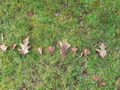 This can include talking about large and small numbers, strategies for solving puzzles, building a Lego model or asking children to give directions along a familiar route. Early maths therefore involves making everyday activities just a bit more mathematical – and enjoyable.
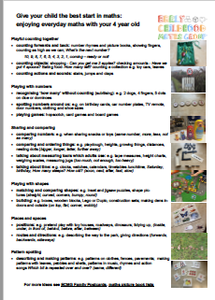 The Early Childhood Maths Group have produced some Best Start in Maths posters for families, which show the most important maths experiences for young children, based on research. These everyday activities include:
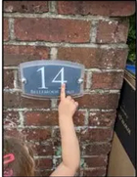
One poster is aimed at families with 4 year olds, and includes activities like spotting numbers outdoors, counting objects and actions, small world play, giving directions to the park and making patterns with leaves and shells.
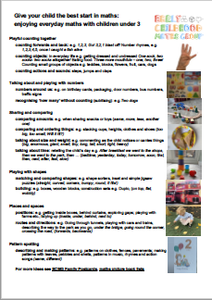 The other poster is for families with children under 3, and includes activities like talking about numbers, playing with stacking cups and shape sorters, and joining in with action rhymes. The posters can be downloaded from the ECMG website. Other resources include Maths Family Postcards, with prompts for conversations in everyday situations (available in several languages) and lists of maths picture books.
We hope that these posters and resources will be useful for settings to share with families. We hope they will encourage families to enjoy maths activities at home with young children, because they can really make a difference to children’s life chances. And we hope they help to create positive attitudes, which may be the greatest challenge we face in giving children the best start with maths.
Dr Sue Gifford is chair of the Early Childhood Maths Group and works as an early years mathematics consultant with practitioners and various official bodies.
Photo acknowledgements: